

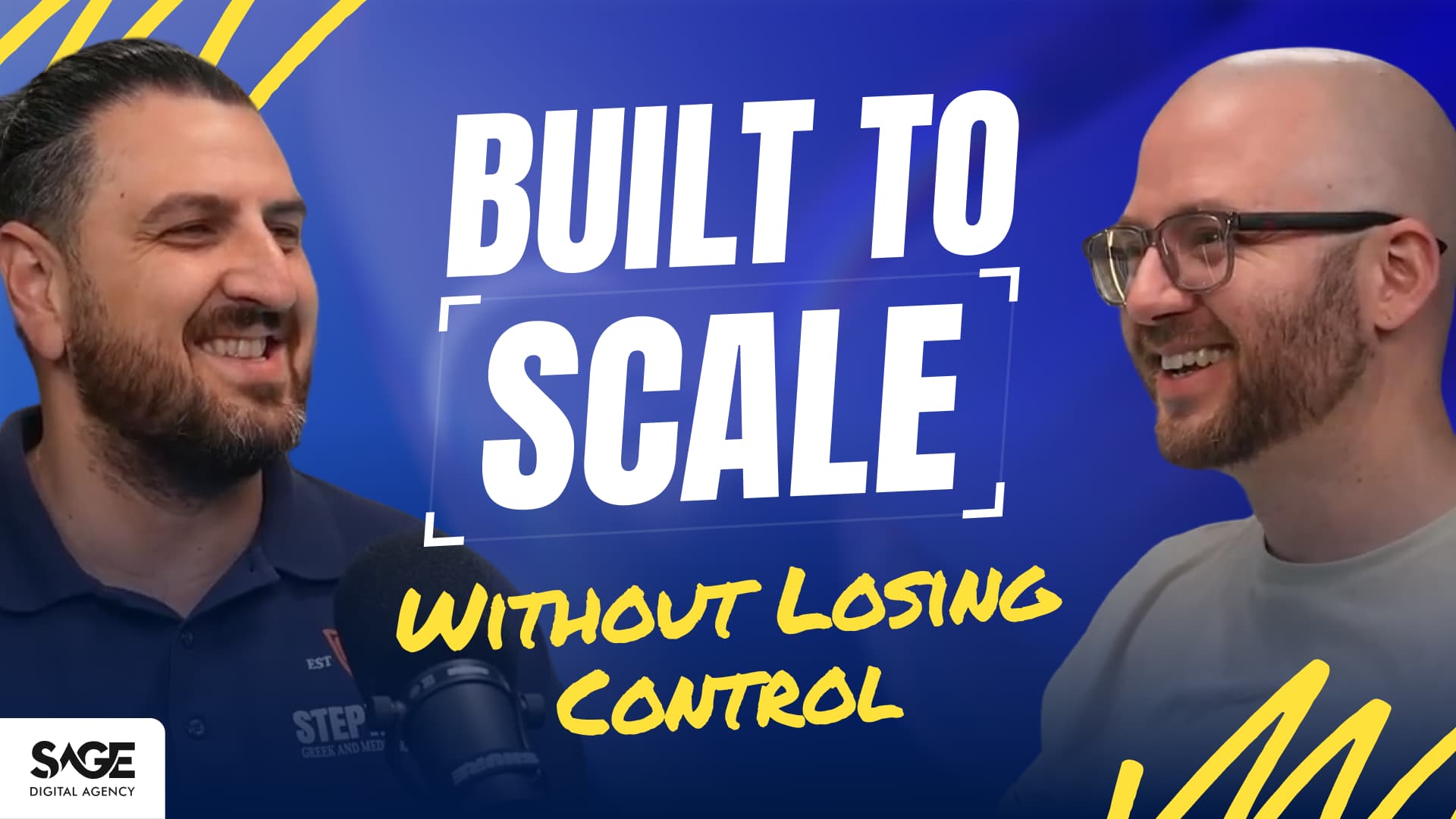
Business owners asking how to scale a business usually have hit the same wall. The owner ends up managing and solving too many small details, to the point of being spread thin.
Alex Jariv has experience running Sage Digital Agency, a web design and digital marketing company in Las Vegas. He knows the pressure that comes with carrying too much himself.
In his conversation with Nick Kossayan, Co-Owner of Stephano’s Greek and Mediterranean Grill, the pattern becomes clear: growth does not fail from ambition alone. Growth fails when the owner stays trapped in every moving part.
That is the real scaling problem.
The first ceiling is the owner
In the early years, full control can feel good. You know what is happening. You can jump in fast. That same habit turns into a growth cap once volume rises.
Nick describes the turning point. With two stores, he was doing everything at the store level: scheduling, call-outs, replacements, customer issues, buyers, daily problems, and whatever else hit that day.
He had two choices. Stay the cashier, manager, fixer, and decision-maker forever, or trust people and grow.
That same ceiling shows up in digital services.
At Sage Digital Agency, Alex frames it through a different workload: hundreds of websites, dozens of clients, and major ad spend with real business consequences attached. The work is different, but the owner’s pressure is the same.
If one person stays at the center of every decision, growth turns into stress, not scale.
What that looks like in practice
A business is still owner-dependent when:
- Every problem routes back to the founder
- Staff waits for approval on low-risk decisions
- Customer issues interrupt the owner at random
- The owner feels informed, yet exhausted
- Growth creates more chaos instead of more capacity
Delegation needs rules
Good delegation has boundaries.
Nick gives a clear example of this in practice. If something is major, bring him in. If it is not major, make a decision and fix it later if the call was wrong. That keeps work moving and gives staff room to build experience and judgment.
That principle pairs well with the Tim Ferriss example Alex brings up from The 4-Hour Workweek. The idea: if a problem can be fixed under a set dollar amount, do it without escalating.
A simple delegation framework
For business owners trying to scale, adhere to this four-part structure:
1. Define the “major issue” category – Staff needs a clear line for what comes up to ownership.
2. Give autonomy on routine problems – Let managers solve low-risk issues on the spot.
3. Review the call after the fact – Use the result as coaching, not punishment.
4. Refine the rule set over time – Delegation gets stronger when boundaries get clearer.
The common mistake here is emotional. Owners say they want people to step up, then punish every imperfect call. That trains hesitation. It does not train leadership.
The better approach? No yelling. No drama. A mistake turns into, “Next time, we’ll do it this way.”
That creates confidence.
Hire people who care, then train hard
Cheap help feels practical in the early years. However, high-skill employees move faster and get it right the first time.
That said, starting pay does not predict the future. Some people come in at a lower rate and give far more than people hired at a higher rate.
Ultimately, find someone who cares and works hard, and promote them. Sage Digital Agency hires for personality and drive, then teaches skills.
The hiring standard that scales
- Personality beats résumé inflation
- Skill can be taught in a lot of areas
- Drive cannot be installed later
- Experience matters more as the company grows
Put the business on paper
Culture alone does not scale. If processes are not on paper, they are hard to explain to staff.
For example, Stephano’s uses playbooks, training manuals, role levels, and testing tied to job progression.
What documentation should do
A playbook is not a binder that sits untouched in a corner. It serves several direct purposes:
- It gives managers a fair reference point
- It keeps standards visible
- It supports training
- It backs up accountability
- It makes repetition easier across locations
A digital marketing team may not run a commissary kitchen, yet it still needs documented workflows, review rules, service standards, escalation paths, and role clarity.
Without that structure, every account becomes a custom fire drill.
Training is also never finished. Owners need to remind staff and bring people back to the standard when drift shows up. Repetition is real training.
Brand consistency lives in operations
At Sage Digital Agency, consistency shows up in the way work gets delivered. A client should not get one level of service from one team member and a weaker version from another.
A website launch, campaign setup, review workflow, or reporting cadence should feel like it came from one company with one operating model. That is what builds trust over time.
This is why consistency has to be operational and requires an established process, be it a web design process or an auditing one. If the internal workflow changes too much from person to person, the client experience starts to drift.
That is the bigger point for Sage Digital Agency and for any growing business. Brand trust comes from repeatable output.
Reviews and feedback need a schedule
Nick used to get review alerts on his phone right away, but then a bad review could hit on a Friday night and ruin the rest of the evening. His wife told him to take it off his phone. He did.
Now he checks reviews in the office during work hours and responds from a calmer place. That small change matters more than it sounds.
The better feedback loop
For Sage Digital Agency, the solution is boundaries. Alex protects his evenings from 5:00 p.m. to 8:00 p.m. for family and wants Sundays to feel different from the rest of the week.
He is clear about the standard: if the team can handle it, they should handle it. He does not want every small issue to turn into a text message during family time.
Likewise, Nick stopped letting reviews hit his phone at random and moved that work into office hours. He wants one day to shut off part of his brain, spend time with family, and give his managers and staff a consistent day off.
That is what a better feedback loop looks like in practice. Not constant interruption. A business runs better when the owner sets real boundaries.
Tech should remove company drag
When a business is responsible for hundreds of websites, dozens of clients, and major ad spend, technology can help.
Sage Digital Agency leverages AI-powered and automation technology to speed its processes where appropriate and to improve quality and output.
Meanwhile, Stephano’s uses Restaurant365 to organize the commissary, track food cost, and compare actuals with theoreticals. Online ordering takes work off the stores and off the owner’s plate.
Good tech should do three jobs:
- Cut repetitive admin and tasks
- Improve output standards
- Allow the business to more effectively serve the customer
If technology adds noise or creates more owner dependency, it is not helping scale.
Grow slower than your ego wants
This may be the hardest lesson. Expansion before readiness can damage the business you already have.
What smart business growth looks like
Here are some signs that expansion is done the right way:
- The current operation can support stronger management hires
- The team can hold standards across more customers
- The owner is not still carrying every daily issue
- The financial cost of expansion is realistic
FAQs
What is the first step in learning how to scale a business?
The first step is freeing up the owner from every decision. If every decision, complaint, or approval loops back to the owner, scale has not started yet. Growth gets real once the owner defines decision rights, documents standards, and gives managers room to act.
How do you delegate without losing control?
You keep control through rules, not constant presence. Define what counts as a major issue, let managers handle routine problems, review their calls later, and coach based on the result. That is how delegation turns into better judgment.
What kind of people should a growing business hire?
People who care, take ownership, and fit the culture. Skill can usually be taught. Drive is usually harder to generate. As the company grows, stronger hires should know more than the owner in their own function.
How do playbooks help with scaling a business?
Playbooks turn verbal standards into repeatable systems. They support training, accountability, job levels, and cross-location consistency. They cut confusion and make it easier to coach from the same reference point every time.
What role does technology play in scaling a business?
Technology should cut repetitive admin and tasks, improve output standards, and allow the business to more effectively serve the customer.
How do you know you are ready to expand?
You are ready when the current operation runs with documented standards, strong managers, stable output, and less owner panic. You are not ready if the founder still acts as cashier, manager, scheduler, and emergency line every day.
Can slowing down growth help a business scale better?
Yes. Expanding before readiness can hurt the base business. Patient growth protects quality and keeps the brand intact.
Key takeaways
- Fix the owner’s bottleneck first. Growth gets cleaner once low-risk decisions stop routing back to one person.
- Delegate with rules. Define what staff can solve alone and what must be brought up to leadership.
- Hire for care and ownership. Better people save time, reduce rework, and raise the standard.
- Put standards on paper. Playbooks, training manuals, and role levels turn culture into repeatable execution.
- Treat consistency like a systems issue. Customers trust brands that deliver the same quality every time.
- Make feedback structured. Scheduled review checks and fast private feedback loops protect owner focus.
- Choose patient growth. The right timing, the right hire, and the right location beat rushed expansion.