




Artificial intelligence has made it remarkably easy to produce something that looks professional.
A website can be generated in minutes. Marketing copy can appear in seconds. An advertising strategy can be outlined before you finish your coffee.
And in many ways, that is extraordinary.
But there is a question businesses need to start asking:
Does easier access to the tools mean everyone using them suddenly has the expertise to do the work?
We do not think so.
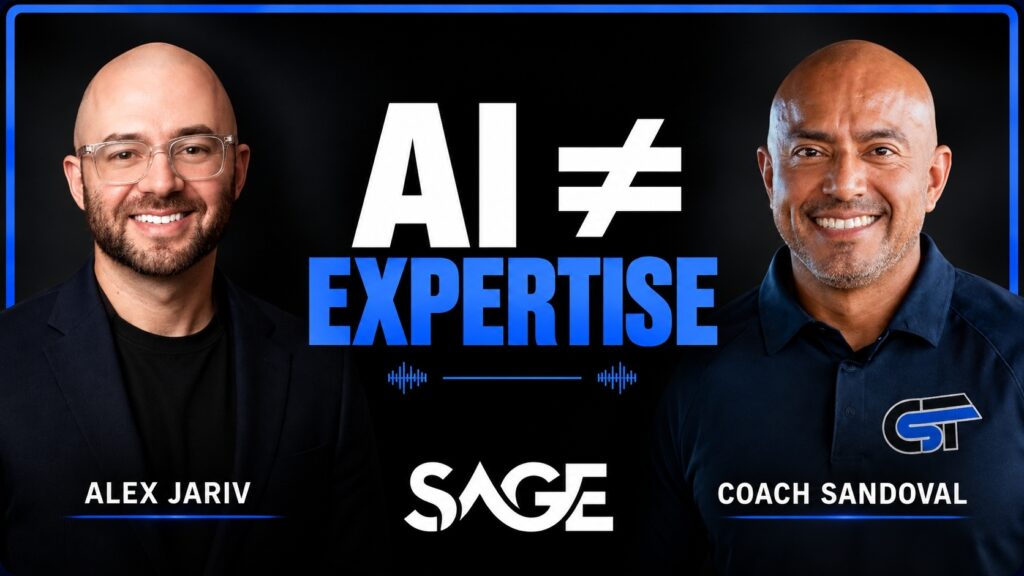
That was the center of a recent conversation on Sage Insights about AI, expertise, professional judgment, and what happens when technology makes it possible to imitate work that previously required years of experience.
The issue is not whether AI is useful.
It absolutely is.
The issue is understanding what AI is good at, what it is not good at, and who should ultimately be responsible for the decisions that affect your business.
AI Has Made It Easier to Look Like an Expert
This is one of the more interesting changes happening in digital marketing.
A person with relatively little web design experience can now generate a polished-looking website.
Someone who has never managed a meaningful advertising budget can ask AI to develop a Google Ads strategy.
Someone without years of copywriting experience can produce reasonably polished marketing copy.
The barrier to creating something that looks professional has fallen dramatically.
That can be a very good thing.
A startup with almost no budget can create its first landing page. A small business owner can develop ideas before engaging an agency. An experienced marketer can produce variations and analyze information much faster than before.
The problem begins when access to a tool gets confused with mastery of the profession.
Those are two very different things.
Looking Right and Being Right Are Different
One of AI’s most impressive characteristics can also be one of its biggest weaknesses.
Its output can look extremely convincing.
The formatting is polished. The language sounds intelligent. The structure makes sense. The design may look clean.
That creates an enormous amount of confidence in the result.
But professional work is rarely just about producing something that looks correct.
It requires understanding context.
Why is the company doing this?
Who is the customer?
What has already been tried?
What is the actual objective?
What constraints exist?
What happens if the recommendation fails?
An AI-generated website may look attractive while completely missing the company’s positioning.
An AI-generated advertising strategy may sound sophisticated while sending money in the wrong direction.
An AI-generated recommendation may technically make sense while being completely impractical for the person expected to implement it.
That is where experience becomes valuable.
You Can’t Fake Expertise
During the conversation, we compared digital marketing to strength and conditioning.
If someone has spent years developing physical strength, understanding athletes, coaching people, and producing results, there is an obvious body of work behind that expertise.
You cannot simply announce one morning that you have it.
Digital services can be different.
AI makes it increasingly possible to manufacture the appearance of capability very quickly.
A polished landing page, attractive mockup, clever presentation, or sophisticated proposal can make someone appear far more experienced than they actually are.
For businesses buying those services, that makes evaluating providers harder.
The question cannot simply be:
“Does this look good?”
Businesses need to ask:
“Does the person behind this actually know what they’re doing?”
Don’t Replace the Practitioner With the Tool
Technology challenging professional expertise is not unique to marketing.
Coach Tony Sando shared an example from sports science.
As new technology began producing increasingly sophisticated information about athletes, coaches had to determine how much authority to give the data.
There was a temptation to allow the numbers to make decisions rather than using the numbers to help experienced coaches make better decisions.
The principle that emerged was essentially this:
Don’t replace the coach with the laptop.
That same principle applies remarkably well to AI.
AI can provide information.
AI can identify patterns.
AI can produce ideas.
AI can analyze enormous amounts of data faster than a person ever could.
But the experienced practitioner still needs to determine what matters, what does not matter, and what should actually be done.
Experience Helps You Know What to Ignore
Early in almost any career, professionals spend enormous amounts of time collecting information.
You learn different techniques. You discover tools. You study methodologies. You experiment.
Eventually, something changes.
Experience starts teaching you what not to do.
An experienced professional may know 30 possible solutions to a problem but recognize almost immediately that only two are appropriate.
That judgment is incredibly valuable.
AI often works in the opposite direction.
It can provide endless possibilities.
Ten strategies.
Twenty ideas.
Fifty recommendations.
But more options do not necessarily create better decisions.
Expertise is often the ability to look at all those possibilities and say:
“We don’t need most of this. This is what actually matters.”
AI Doesn’t Always Understand the Real World
One example from the conversation illustrated this perfectly.
AI was used to help construct a professional-looking fitness program based on information that had been provided to it.
On paper, the result looked impressive.
But an experienced coach immediately recognized problems.
The program did not sufficiently account for the person’s lifestyle. Some exercises weren’t realistic for the individual. The expected workout duration did not match the available time.
The information itself wasn’t necessarily bad.
The context was missing.
That distinction matters enormously.
Businesses have context too.
There are budgets.
Employees.
Customers.
Internal politics.
Past experiences.
Technology limitations.
Competitive pressures.
Timelines.
Goals.
Personal preferences.
There are hundreds of variables that rarely fit neatly inside a prompt.
A professional who understands the organization can incorporate those variables into the decision.
The Best Use of AI Is to Make Experts Better
This is where the conversation about artificial intelligence becomes far more optimistic.
AI is not something professionals should avoid.
Quite the opposite.
The opportunity is enormous.
We use AI.
We experiment with it.
We use it to think through ideas, analyze information, accelerate workflows, challenge assumptions, generate starting points, and sometimes identify things we had not considered.
The important distinction is who is driving the process.
An experienced professional using AI has the ability to evaluate what comes back.
They can recognize a bad recommendation.
They can identify where context is missing.
They can change direction.
They can combine the technology’s capabilities with years of experience.
That can create dramatically better work.
AI Should Help You Ask Better Questions
There is also an important role for AI on the client side.
Business owners should absolutely use these tools.
Use AI to educate yourself.
Use it to understand terminology.
Use it to prepare questions before meeting with your marketing company.
Use it to challenge an idea.
Use it to understand competing approaches.
Use it to get another perspective.
An informed customer is a good customer.
But there is a difference between becoming more informed and assuming that information makes professional expertise unnecessary.
Reading about medicine does not suddenly make someone a physician.
Learning about accounting does not eliminate the value of a great CPA.
And having access to AI-generated marketing recommendations does not automatically make someone an experienced marketer.
Digital Marketing Has Real Consequences
This matters even more when businesses begin spending significant money.
A website isn’t always just a digital brochure.
It may be the destination for thousands of dollars in Google Ads, Meta advertising, SEO, email marketing, social media, referrals, and other campaigns.
If the website fails to convert, the consequences extend far beyond the cost of building the website itself.
The same applies to advertising.
AI may eventually become extraordinarily capable at managing campaigns. It already plays an enormous role inside advertising platforms.
But businesses still need someone accountable for understanding the strategy, interpreting the results, recognizing problems, and determining where money should be spent.
There is a major difference between automating parts of the work and blindly turning over responsibility for the outcome.
Beware of “Good Enough”
One of the biggest risks AI creates is the proliferation of work that is good enough at first glance.
The site looks fine.
The copy sounds fine.
The advertisement looks fine.
The strategy document looks impressive.
That makes it tempting to stop asking questions.
But professional work often lives in the details.
What happens after someone clicks?
Is the message consistent?
Does the website communicate why someone should choose the business?
Can the marketing be measured?
Does everything work correctly on mobile?
Is the technology reliable?
Does the advertising connect logically to the landing page?
Can someone identify why performance changed?
Who is accountable when something goes wrong?
Those questions become difficult to answer when the entire value proposition was simply speed and automation.
The Future Is Expertise Plus AI
Nobody knows exactly where artificial intelligence will be five years from now.
Some assumptions we make today will probably look ridiculous in hindsight.
AI will become better.
Tasks that currently require professionals may become increasingly automated.
Entire workflows will change.
That should not be ignored.
But today’s opportunity is much clearer.
Take people who already know what they’re doing and give them extraordinary tools.
Let great designers use AI.
Let great developers use AI.
Let great marketers use AI.
Let great writers use AI.
Let experienced professionals automate repetitive tasks so they can spend more time thinking about the difficult ones.
That is far more compelling than pretending expertise no longer matters.
Tools Are Easier to Access. Expertise Still Has to Be Earned.
AI has democratized access to capabilities that were unimaginable only a few years ago.
That is exciting.
It should create better businesses, better professionals, and better work.
But businesses should remain thoughtful about the distinction between possessing the tool and possessing the judgment required to use it well.
Artificial intelligence can make an expert dramatically more capable.
It can also make an inexperienced person look like an expert.
Knowing the difference may become one of the most important skills businesses develop in the AI era.
At Sage Digital Agency, our approach is straightforward:
Use the best technology available. Embrace AI. Keep learning. Keep experimenting. But never confuse the tool with the expertise required to produce the result.
Keep exploring
 Digital MarketingSEO vs Google Ads: Where Should You Actually Spend First?Read the guide
 Web DesignWhy Most Business Websites Don’t Generate LeadsRead the guide
Want help with this? See our SEO and AI search visibility.