






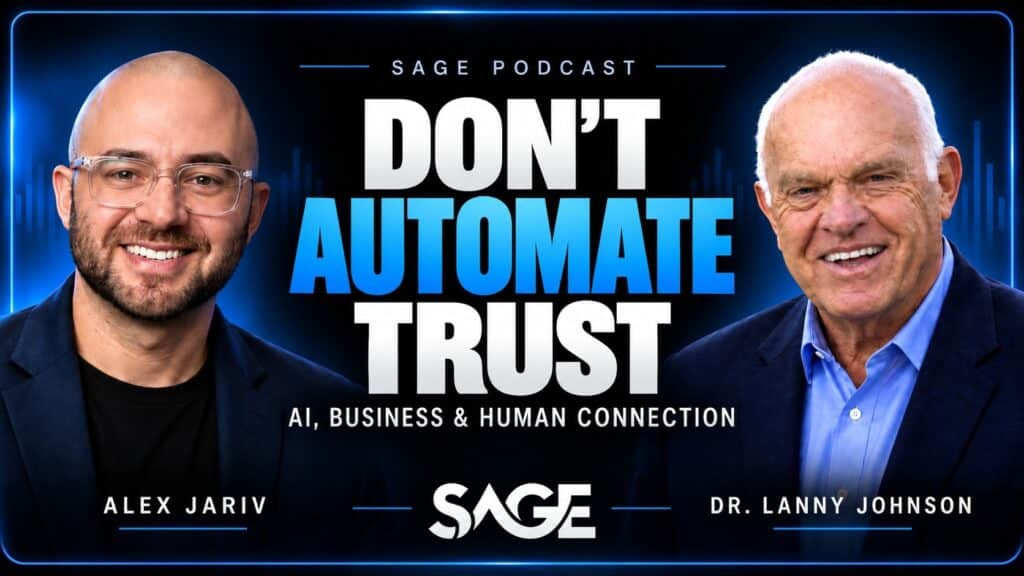
What can a digital agency owner and an orthopedic surgeon learn from each other about business? Quite a lot, especially when the conversation turns to trust, communication, and the growing influence of artificial intelligence.
Technology has made it easier than ever to communicate. We can automate emails, respond to inquiries instantly, generate content in seconds, and use artificial intelligence to help manage entire business processes.
But here’s something I’ve been thinking about lately: Are we becoming better at communicating, or are we simply communicating more?
I recently sat down with Dr. Lanny Johnson, a pioneering orthopedic surgeon and medical innovator, for another conversation on Sage Insights. We come from very different professional backgrounds, but I’ve always appreciated the similarities in how we think about our work.
This conversation covered everything from artificial intelligence and digital marketing to client relationships, professional standards, and patient care.
And the more we spoke, the more we returned to one central idea.
Technology can make us more efficient, but genuine relationships remain the foundation of successful businesses.
Business Is Built on Relationships
Dr. Johnson opened our conversation with a remarkably simple observation:
“Business is based on relationships.”
He went on to explain that relationships depend on communication.
It’s a straightforward principle, but one I believe too many businesses overlook.
At Sage Digital Agency, we’re fortunate to work with hundreds of businesses. As our client base has grown, one of my biggest responsibilities has been ensuring that our clients continue to feel supported, informed, and connected to our team.
When you’re managing five relationships, staying in touch is relatively easy. When you’re managing hundreds, it becomes more complicated.
But the importance of communication doesn’t diminish as a business grows.
Clients should hear from you before there’s a problem. They should know who’s responsible for their work, understand what happens next, and feel comfortable reaching out when something needs attention.
A successful client relationship shouldn’t consist entirely of responding to complaints or support requests.
It should be an ongoing relationship built on confidence, accountability, and trust.
AI Is Changing Communication. But Is It Making It Better?
One subject I particularly wanted to discuss with Dr. Johnson was the increasingly common use of AI-generated communication.
Artificial intelligence is extraordinary technology. I use it, recommend it, and continue to explore ways to incorporate it into our businesses.
But I’m also seeing something that concerns me.
People are beginning to use AI to communicate with other people in situations where a brief, genuine conversation would be far more productive.
I’m not talking about using AI to improve grammar, summarize information, or organize thoughts. Those are genuinely useful applications.
I’m talking about taking a complicated, AI-generated message, sometimes filled with technical assumptions or questions the sender may not fully understand, and delivering it to another person as though it represents a carefully considered position.
It can create unnecessary work, confusion, and friction.
And I find myself wondering where this ultimately leads.
Are we moving toward a world in which my AI communicates with your AI, and neither of us has a meaningful conversation?
Dr. Johnson offered a perspective I appreciated. He uses AI as an adjunct to his own thinking, not as a substitute for it.
That distinction matters.
The real opportunity is to use artificial intelligence to make people more capable, better informed, and more productive.
The danger is allowing convenience to replace judgment, personal responsibility, and authentic communication.
The goal shouldn’t be to remove people from every interaction. It should be to make the interactions that matter more effective.
Automation Should Create Better Human Conversations
Of course, there’s another side to this discussion.
At Sage, we’ve invested substantially in automating parts of our sales and client acquisition process.
When someone visits our website and expresses interest in our services, we don’t simply provide a generic contact form and hope somebody follows up eventually.
Instead, we’ve built a structured process that collects important information, asks qualifying questions, and gives appropriate prospects the opportunity to schedule a conversation.
We also use automation to respond rapidly to inquiries, sometimes within 60 seconds.
Dr. Johnson challenged me on whether requiring someone to use an online calendar might create an unnecessary barrier to communication.
It’s a fair question.
My response was that the calendar is only one part of the process. We capture relevant information before someone reaches the scheduling stage, which allows our team to follow up even if the individual doesn’t complete a booking.
The ultimate objective isn’t to force somebody through automation.
It’s to determine whether we can help them and, when appropriate, get into a meaningful conversation as quickly as possible.
That’s an important distinction.
Good automation removes unnecessary administrative work. It shouldn’t remove the opportunity for personal attention.
Clients Aren’t Buying Marketing. They’re Buying Business Outcomes.
Another interesting moment came when Dr. Johnson asked me a question that every agency owner should be prepared to answer:
How are you going to make money for your client?
It’s a much better question than asking how much a website costs or how many advertisements an agency will create.
When a business hires Sage, they’re not simply purchasing a WordPress website, Google Ads management, or Meta advertising.
They’re investing in an outcome.
They want more qualified inquiries, stronger visibility, better conversion rates, increased revenue, or a more successful business.
That means our responsibility extends beyond delivering individual services.
We need to understand what the client sells, what their margins look like, how much they’re prepared to invest, and whether the underlying economics make sense.
A marketing campaign can produce leads and still fail commercially if the customer acquisition cost doesn’t support the business model.
Likewise, a beautiful website isn’t necessarily a successful website if it doesn’t help accomplish the business’s objectives.
I shared a principle that I’ve repeated for years:
“I help winners win more.”
I want to work with businesses that care about improving, have something valuable to offer, and are committed to creating better outcomes.
Marketing isn’t a miracle cure for every struggling business. It’s a tool that can amplify an already viable business when the strategy, budget, and expectations are properly aligned.
High Standards and Professional Integrity
Dr. Johnson spent decades performing orthopedic surgery and developing medical innovations.
During our discussion, he described the intensity with which he approached surgery and the expectations he placed on the people working alongside him.
His standards were exceptionally high, but importantly, they were standards he first applied to himself.
That resonated with me.
I’ve sometimes described my desire to outperform competing agencies as being driven by ego. I want our websites to be better, our campaigns to be more effective, and our clients to receive exceptional work.
Dr. Johnson encouraged me to consider a different word: integrity.
I think that’s a better way to describe it.
Professional pride isn’t necessarily about proving you’re superior to somebody else.
It’s about knowing what good work looks like and being unwilling to settle for something less.
For me, that includes the small details of the client experience.
When someone signs an agreement and makes a deposit, what happens next? Are they welcomed properly? Do they know who their project manager is? Does the work begin in an organized manner?
Those moments matter.
Great design and sophisticated technology are important, but they don’t excuse poor execution or a frustrating customer experience.
Do Excellent Work. Let the Financial Rewards Follow.
We also discussed the relationship between money and professional purpose.
Dr. Johnson shared a lesson that stayed with me: when money becomes the primary reason for doing something, it can begin to shape every decision that follows.
His philosophy was to focus on doing genuinely good work and allow the rewards to come afterward.
I agree with that.
Of course, Sage is a business. We have employees, expenses, obligations, and a responsibility to operate profitably.
But the satisfaction of doing this work isn’t limited to receiving payment.
It’s hearing from a client who is thrilled with their new website.
It’s seeing a campaign create meaningful opportunities for a business.
It’s knowing that the work we delivered has made somebody else’s professional life better.
That satisfaction is difficult to replace.
And I believe businesses that consistently focus on delivering excellent work put themselves in a much stronger position to achieve lasting financial success.
What Healthcare Can Teach Us About Customer Experience
One of the most interesting parts of our conversation involved the doctor-patient relationship.
I shared a personal experience involving surgery that had a tremendously positive outcome, but very limited direct communication with the surgeon.
I had enormous respect for the physician’s capabilities. What I would have appreciated, however, was more education about the procedure, the recovery, and what I should expect along the way.
This led to an important discussion about how healthcare professionals could use video and digital communication to improve the patient experience.
Imagine receiving a thoughtful video from your surgeon before a procedure explaining what will happen, what questions patients commonly ask, and how to prepare.
Then imagine receiving another video after surgery explaining the typical recovery process, what to expect at different stages, and when to contact the medical team.
The physician wouldn’t necessarily need to record a completely new video for every patient.
A library of carefully prepared, reusable educational content could help patients feel more informed while allowing medical teams to communicate more consistently.
It could also supplement, rather than replace, the individualized information and conversations required for medical care.
Dr. Johnson shared how he had experimented with computerized medical records and interactive patient education decades before today’s digital communication tools became commonplace.
His underlying objective was remarkably similar: help patients understand their care and establish a stronger relationship with the physician treating them.
One observation particularly stood out.
A surgical team may perform hundreds of similar procedures, but the person undergoing an operation is experiencing that procedure personally, often for the first and only time.
That patient’s perspective matters.
And there’s a direct parallel to the work we do in business.
We may build hundreds of websites, but for the client trusting us with their project, this particular website could represent an enormous investment and an important moment in the life of their company.
Experience should make us better at serving people, not less attentive to the significance of their individual circumstances.
Use Content to Scale Your Expertise, Not Your Personality Away
As our conversation continued, we explored the value of video, podcasts, and educational content in professional services.
A business owner can only participate in so many personal conversations each day.
But a thoughtful video can introduce your perspective, explain your process, and answer questions for hundreds or thousands of people.
I’ve seen this firsthand.
Prospective clients sometimes arrive at an initial conversation having already watched a substantial amount of our content.
They understand how I think, what Sage values, and what kind of working relationship they can expect.
That changes the nature of the conversation.
Instead of beginning as complete strangers, we’re often starting with a meaningful degree of familiarity.
There’s an enormous opportunity for physicians, attorneys, consultants, and other professionals to use content in the same way.
The purpose isn’t to manufacture a relationship that doesn’t exist.
It’s to communicate knowledge, expectations, and personality at scale, while preserving the opportunity for real human engagement when it’s needed.
The Future Belongs to Businesses That Use Technology Thoughtfully
I’m optimistic about what technology can accomplish.
AI can accelerate research, organize information, improve workflows, and help businesses accomplish things that would previously have required far more time and resources.
Automation can make organizations more responsive and efficient.
Video can make professional expertise accessible to more people.
But none of those capabilities eliminates the responsibility to care about the person on the other side of the interaction.
That’s ultimately what I took away from this conversation with Dr. Johnson.
Businesses should continue embracing useful technology, but without sacrificing the judgment, integrity, and relationships that make their work valuable.
The objective isn’t to automate everything. It’s to become more effective at the things that matter.
And in business, as in medicine, those things will always include the people we’re here to serve.
This article is based on a conversation between Alexander Jariv and Dr. Lanny Johnson on Sage Insights, the business and technology podcast from Sage Digital Agency.
Watch the full episode above to hear our discussion about artificial intelligence, relationships, marketing, professional standards, and the future of communication.
Explore more conversations on Sage Insights, including our previous discussion with Dr. Johnson about trusting the experts you hire.
Keep exploring
 Web DesignWhat to Ask When Hiring a Digital Marketing Agency: How to Choose the Right AgencyRead the guide
 InsightsHow to Choose a Web Design Agency to Work WithRead the guide
Want help with this? See our digital marketing services.