




I recently sat down with Jack Adams, owner of Atomic Wraps, for a conversation that reminded me how similar our industries really are.
Jack wraps vehicles. My team designs, builds, hosts, and markets websites.
On the surface, those sound like completely different businesses. But the more we talked, the clearer the connection became.
Clients often underestimate the work. They see a clean finished product and assume the process must have been simple. A vehicle wrap looks like a large sticker. A website looks like a collection of pages.
Neither is true.
Behind a professional vehicle wrap are design decisions, measurements, templates, materials, seams, handles, body lines, installation methods, and years of practical experience.
Behind a professional website are strategy, messaging, design, development, mobile behavior, performance, tracking, SEO, paid traffic, CRM connections, and the path a visitor takes before becoming a customer.
Different industries. Same problem.
The finished result often looks much easier than the process required to produce it.
Good Design Starts With Knowing What Not to Change
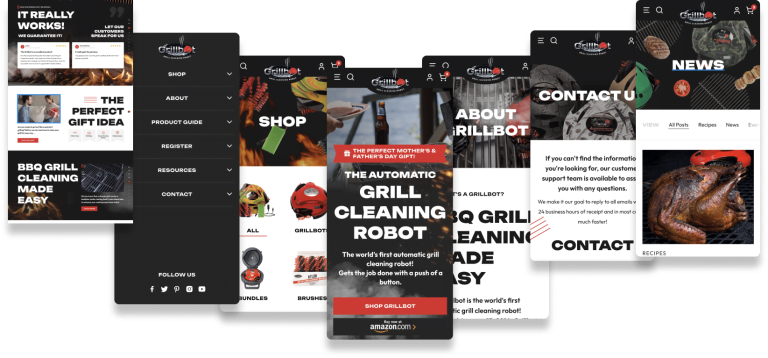
When Jack first came to Sage, I did not look at the Atomic Wraps website and tell him that everything needed to be redesigned.
I could have.
That would have created a larger project and made us more money. It also would have been the wrong recommendation.
Atomic Wraps already had a memorable brand. The website had personality. It had good bones. It did not need to become something completely different just because a web designer wanted to put his own stamp on it.
This happens far too often.
A business owner comes in with something that is already working in certain ways. Instead of understanding what should be preserved, the designer wants to blow everything up and start over.
I do not believe that is always the right approach.
My question is usually simpler:
What is the least we can do to create the best result?
Sometimes the brand does not need to be reinvented. Sometimes the website needs cleaner navigation, stronger service pages, better mobile presentation, clearer calls to action, more accurate tracking, or a better process after a lead comes in.
Experience is not only knowing what to create.
It is also knowing what should not be touched.
The Driver Side Is the Homepage
One of my favorite lines from the conversation came when Jack explained:
“The driver side is my homepage.”
That is a perfect comparison.
When Atomic Wraps begins designing a vehicle, the team does not necessarily design every side at once and hope the client likes the finished result.
They begin with the driver side.
That side establishes the direction. It defines the visual style, scale, hierarchy, and overall composition. Once the client approves that primary view, the design can be carried across the rest of the vehicle.
That is exactly how we approach a website homepage.
The homepage is not the entire website, but it establishes the foundation. It sets the visual direction, messaging hierarchy, tone, spacing, content style, and primary conversion path.
If the homepage is wrong, designing another 20 pages does not solve the problem.
It usually creates 20 more versions of the same problem.
Business owners are understandably excited when beginning a website project. They want to discuss every service page, gallery, location, testimonial, feature, and idea they have collected over the previous five years.
But good projects require focus.
Get the primary view right first. Then allow the rest of the project to follow.
The driver side is the homepage.
That line should probably be on a T-shirt.
An AI Mockup Is Not a Finished Website
Jack and I also discussed something both of us encounter regularly.
A customer arrives with a design and says:
“You do not need to design anything. Just build this.”
In Jack’s world, it might be a graphic created in Canva that the customer wants placed on a vehicle.
In my world, it might be an AI-generated homepage, a Figma file, or a landing page concept created by another marketing company.
Sometimes those materials are helpful.
They can communicate the client’s preferences. They can establish a direction. They can reduce some of the early exploration required to understand what the client has in mind.
But direction is not the same as completion.
A vehicle is not a flat Canva canvas. It has handles, windows, seams, hinges, curves, badges, body lines, and real-world viewing angles. The design has to remain readable when the vehicle is moving and must be installed without damaging the surface beneath it.
A website is not a static screenshot.
It has to work across desktop, tablet, and mobile. It has to load quickly. It must support clear calls to action. Forms must work. Tracking must be configured. The design must connect to the campaign, offer, audience, and business objective.
A mockup can look excellent while ignoring nearly all of those things.
AI Offers Direction, Not Professional Judgment
I want to be clear about my position on AI.
I am not anti-AI.
I use it. My team uses it. I think it is an extraordinary tool.
AI can help experienced professionals organize ideas, explore concepts, structure content, improve workflows, review information, and reach a stronger first version faster.
The issue is not the tool.
The issue is the operator.
AI has also created a dangerous illusion. A person with no design experience, technical understanding, strategic process, or developed taste can now generate something that looks reasonably finished in a matter of minutes.
That appearance of completion creates confidence.
Someone builds one AI website. They prompt one landing page. They generate one logo. Suddenly, they feel like they understand web design, branding, or marketing.
This is where the Dunning-Kruger effect becomes relevant.
When someone has limited experience in a subject, they may not yet understand how much they do not know. The first result looks impressive, so confidence rises before competence has had time to develop.
I am not judging from a distance.
I was there once.
When I began building websites in 2012, I used templates. I worked hard, tried to make clients happy, and did the best I could with what I knew at the time.
But looking back, I can clearly see that template customization was not the same as real custom web design.
It was part of my learning curve.
AI can help someone build something.
Experience helps determine whether it should have been built that way in the first place.
Templates Are Losing Their Advantage
For years, the inexpensive website market was largely based on templates.
Someone purchased a theme, replaced the logo, changed the colors, inserted the client’s content, and described the result as a custom website.
For certain businesses, that served a purpose.
A startup testing an idea may not need a large custom project. A new business with limited resources may simply need to establish an online presence and determine whether the concept has potential.
There is nothing wrong with choosing a limited solution when you understand what you are buying.
But AI and modern website builders are making the traditional template model less relevant.
If a business wants something generic, it can now generate something generic faster than ever.
That changes where professional web designers create value.
The value is no longer in selling pages or installing a theme.
The value is in strategy, positioning, messaging, design judgment, conversion planning, technical execution, tracking, ownership, and long-term support.
The value is in understanding the business well enough to make the right decisions.
The value is often in knowing what not to do.
Cheap Work Usually Skips the Part You Actually Needed
Every skilled service business eventually hears the same response to its pricing:
“That much? I know somebody who can do it cheaper.”
Jack hears it with vehicle wraps.
I hear it with websites.
Not every business needs a $20,000 or $40,000 website. I understand that. If someone is testing a business concept, using an inexpensive builder or AI-generated site may be perfectly reasonable.
But the standard changes when the business is established and the website is expected to produce measurable results.
A serious business website may need to answer questions such as:
- How will the page support Google or Meta campaigns?
- What happens after someone fills out a form?
- Are calls and form submissions being tracked accurately?
- Does the CRM capture and organize the lead?
- Does someone receive an immediate text or email?
- Can the marketing team determine which campaigns produced actual sales?
- Is the website structured to support SEO and future content?
- Can the business easily manage and expand it later?
Cheap website projects often skip the parts the business actually needed.
The owner receives pages, but not a system.
The cheapest website is not always the cheapest decision.
Sometimes it is simply the first invoice before the real invoice.
Paid Traffic Changes the Standard
A basic website can sometimes survive when only a small number of people visit it.
Paid media changes the equation.
When a business begins paying for Google Ads or Meta traffic, every weakness on the website starts costing money.
A slow page costs money.
A confusing headline costs money.
A poorly explained offer costs money.
A weak mobile layout costs money.
A broken form costs money.
A missed call with no follow-up process costs money.
At that point, the website is no longer just a website. It becomes part of the advertising investment.
A business can save several thousand dollars on web design and then waste far more than that sending paid traffic into an ineffective experience.
Paid campaigns expose website problems quickly.
That is why “good enough” depends entirely on what you expect the website to do.
For a proof of concept, good enough may truly be good enough.
For a serious company investing heavily in growth, it probably is not.
A Website Is Only One Part of the System
A beautiful website does not automatically create business.
The ads may be wrong.
The offer may be unclear.
The tracking may be broken.
The CRM may be disorganized.
The phone may not be answered.
The lead may receive no text, email, or follow-up call.
Then everyone looks at the marketing report and wonders why the campaign did not work.
That is why we increasingly think about the complete system at Sage.
Depending on the client, that can include the website, Google Ads, Meta advertising, analytics, reporting, call tracking, CRM setup, and lead follow-up.
Not every client needs every service.
But the handoffs between those services are often where things break.
An agency may generate a lead and declare victory. The sales team may say the leads were bad. The business owner may not know which source produced the inquiry. Nobody may know whether the person was ever contacted.
That is not serious marketing.
Marketing can create opportunities. The business still has to answer, follow up, sell, and deliver.
But without proper tracking and a connected process, everyone is guessing.
I do not like guessing.
The Tool Is Not the Trade
This is ultimately where websites and vehicle wraps overlap.
Canva is a tool.
Figma is a tool.
WordPress is a tool.
AI is a tool.
A printer is a tool.
Vinyl is a material.
Owning or using the tool does not automatically create expertise in the trade.
The professional understands how the pieces connect. The professional sees problems the customer may not know to look for. The professional takes responsibility for decisions that affect the final result.
That is what craft really is.
Craft is knowing that the homepage should establish the direction before the rest of the website is designed.
Craft is knowing that a vehicle wrap must account for the physical shape and condition of the vehicle.
Craft is knowing when a client’s existing brand should be preserved rather than replaced.
Craft is understanding that the visible result is only the final layer of a much deeper process.
The client does not need to understand every technical detail.
That is why the professional was hired.
But the details still exist.
Less Is More, but Less Requires Experience
Business owners naturally want to communicate everything.
Every service. Every advantage. Every phone number. Every certification. Every feature. Every possible reason someone might choose them.
That instinct appears in both vehicle wraps and websites.
But a moving vehicle is not a brochure. Someone may only see it for a few seconds. The message has to be immediate.
A homepage works similarly.
The visitor needs to understand who you are, what you do, why it matters, and what action to take next.
Giving someone more information does not always create more clarity.
Sometimes it creates more decisions, more confusion, and more opportunities to leave.
Simple design is not lazy design.
Good simplicity requires discipline. It requires someone to determine what deserves attention, what should be secondary, and what should be removed completely.
That judgment is part of the work.
Do It Right Once
The lesson is not that every business should purchase the most expensive possible solution.
The lesson is that business owners should understand what they are buying.
If you need a temporary site to test an idea, use a temporary solution.
If you are not sure the business will work, do not invest money you cannot afford to lose.
If a template or AI builder satisfies the actual business requirement, there is nothing wrong with using one.
But if your company is established, your reputation matters, and you are investing in marketing and growth, the calculation changes.
Cheap work becomes expensive when it has to be replaced.
It becomes expensive when the website wastes advertising dollars.
It becomes expensive when inaccurate tracking leads to poor decisions.
It becomes expensive when the project drags on for months because the least expensive vendor cannot finish it.
It becomes expensive when the business pays once to build it and again to build it correctly.
The tool is not the trade.
The mockup is not the strategy.
The template is not the brand.
The click is not the customer.
The website is not the entire system.
Doing it right once requires experience, judgment, process, and accountability.
In the long run, that is often the less expensive decision.
Frequently Asked Questions
Is AI good enough to build a business website?
AI can be enough for an early proof of concept or a business that simply needs a basic online presence. It can also help organize ideas, draft content, and create an initial design direction. However, if the website must support paid advertising, SEO, lead generation, tracking, CRM integration, and sales, AI alone is usually not enough.
Why does custom web design cost more than a template?
Custom web design requires strategy, original design work, development, mobile refinement, performance optimization, tracking, testing, and launch preparation. A template provides a starting layout, but it does not necessarily address the company’s specific audience, goals, positioning, or technical requirements.
Should every website be completely redesigned?
No. A website may already have a strong brand, useful content, valuable rankings, or pages that produce leads. In those cases, focused improvements may create a better result than starting over completely.
Why do inexpensive websites sometimes cost more later?
Low-cost projects often reduce or eliminate planning, custom design, testing, tracking, SEO preparation, conversion strategy, and quality assurance. If the site later needs extensive repairs or a complete rebuild, the business loses time and pays twice.
What is the relationship between web design and paid advertising?
Paid advertising sends visitors to the website. If the website is slow, unclear, confusing, or poorly structured, the campaign becomes less efficient. A strong website gives the advertising a better chance of turning paid traffic into real opportunities.
What should I ask before hiring a web design company?
Ask what they would preserve from your current website, what they would change first, whether the design is truly custom, how they approach mobile design, how they use analytics, and how the website will connect with advertising, tracking, CRM systems, and lead follow-up.